
There Is No God
And You Just Cannot Get Rid Of Him*

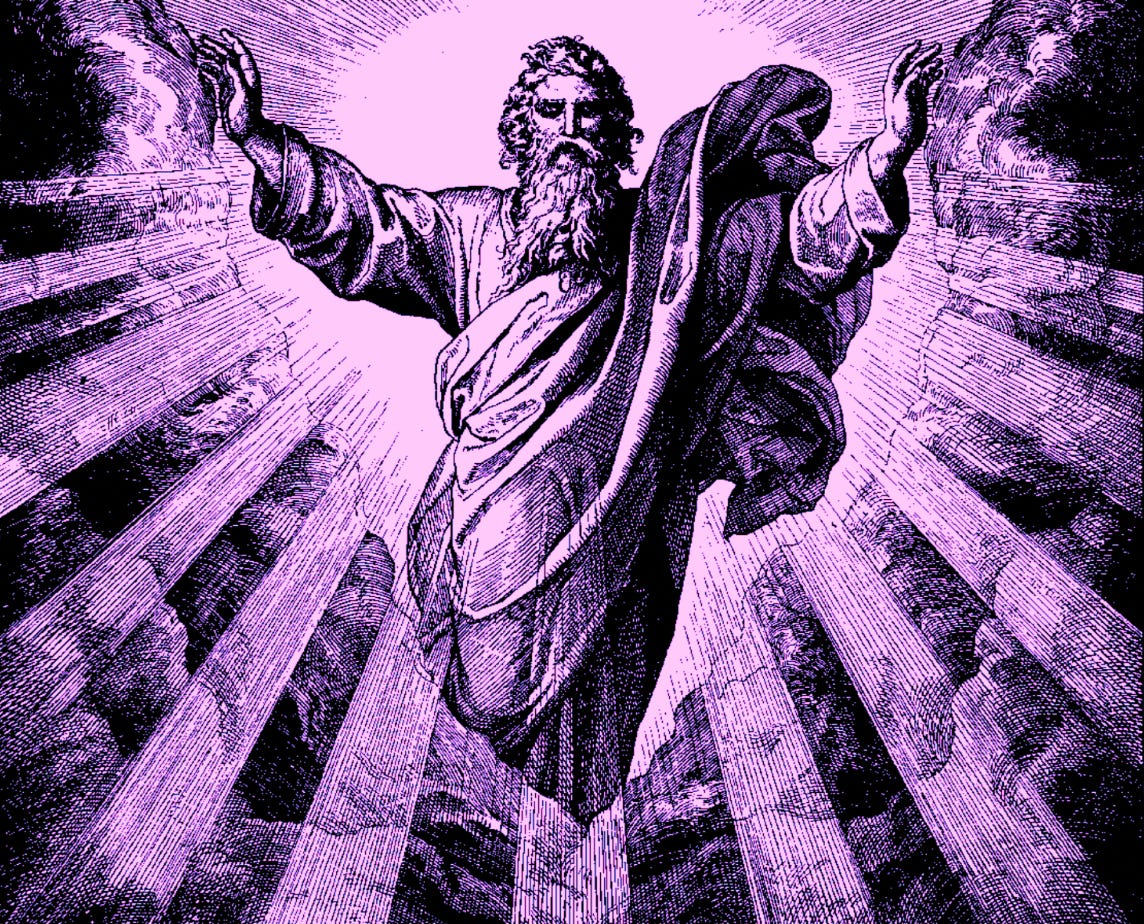
Every spring, there is a huge debate in Finland about a special hymn that has traditionally been sung at the end of school year celebrations. It is a song about the beauty of nature and God’s goodness and grace.
As surely as lilacs burst into bloom at the end of May, anti-theists and freethinkers begin their annual campaign, accusing schools of religious indoctrination.
This year, a parent even sued his children’s school over the issue and demanded considerable compensation for the hurt he felt because his children’s rights as non-believers had not been respected.
He won the case.
And yet in most schools, the hymn is still sung. Those who feel offended by it are excused and may leave the venue.
I find the hymn issue curious.
I understand why some folks want to distance themselves from everything religious. The dad who sued the school was traumatised by his family’s rigid religiosity and wanted to protect his kids from the danger of indoctrination. I get it. But a traditional hymn sung in the end-of-year ceremonies at schools, where God is mentioned a couple of times? Could something like that really break anyone’s soul and seduce her into believing in Divinity against her will?
One would think that for a non-believer, the whole God concept is as irrelevant as Santa Claus. We all sing about Santa, and I haven’t heard anyone getting offended.
But God and religion are sensitive matters, particularly in Finland.
The fuss around the hymn is not so much about God as it is about religion. Many seem to think they belong together like horse and carriage, but I don’t.
Religions did not invent God. If there is such a magnificent superpower as we believe God to be, then there was God before any humans and most certainly before organised religions.
What religions did was kidnap God and customise God to fit their idea of the Almighty. As the writer Reza Aslan has said, God created man in His image, and then man created God in his. We are biologically hardwired to anthropomorphise everything, including the Divine. We project our own emotions, morality, and flaws onto God.
We cannot think about God outside religions. And I think this is a great shame. For I think we need God, but I am not sure we need religions.
But, surprisingly, both seem to be here to stay. Even though we now know so much and even though religions have caused so many bad things, they are still surprisingly popular.
It also does not seem to matter that religions do not make much sense. Because they don´t. They are mostly weird. I am not talking only about Mormonism and Jehovah’s Witnesses, but also Christianity.
Jesus, on whose teachings Christianity is said to be founded, made a lot of sense, but for some peculiar reason, strange concepts, such as the Virgin Birth, Original Sin, the Holy Trinity, and the sacrificial death and resurrection of Jesus, were added later to what became the Christian Doctrine. All of these were add-ons, constructs of several smart men who apparently felt the need to complicate things because love just wasn´t enough.
The result is that Christian doctrine became so complicated that a special academic discipline called theology was needed to explain it. And yet there is still no consensus on what Jesus actually taught. Instead, there are tens of thousands of Christian denominations.
I find this truly bizarre.
What is worse, there are “Christian” movements that have turned Jesus’ teachings upside down and inside out. Like American Evangelical Christians, who have invented something called the Prosperity Gospel, which is as far from Jesus’ teachings as a hedge fund is from the Sermon on the Mount. Not to mention guns, which Jesus condemned, but which these “Christians” have sanctified, because they just love their guns so much. Or something.
Unlike the USA, Finland is a secular Nordic country. Religion is considered a private matter. Kind of. But not quite.
In truth, Christianity still has a strong grip on us.
Sixty-two per cent of Finns (3.5 million people) are members of the Evangelical Lutheran Church of Finland. More than 70 per cent of teenagers attend confirmation camps, where they learn the basics of the Christian faith and are then confirmed, becoming full members of the Lutheran Church and entitled, for example, to have a church wedding.
Confirmation camps are popular because they give 15-year-olds a chance to spend time together over the summer, have fun, and sing Jesus songs while pondering life’s essential questions with cool young pastors.
More than 90 per cent of Finns, and yes, even many who are not church members, are buried in churchyards after a religious ceremony because... I really don’t know why. I guess even non-religious people prefer to send their loved ones to wherever they think the dead are going with some religious rhetoric because they find holy rituals and ceremonies comforting. This is understandable. Ceremonies and rituals have always been important to humans, particularly in times of transition.
I find it very difficult to figure out the Finnish attitude toward spirituality in general and religion in particular. But the way we see God is downright bipolar.
When our previous President wished citizens God’s blessing in his New Year’s speech, it caused an uproar. The President mentioning God was somehow too much. But no one seems to mind the fact that the Finnish Parliament opens its annual session with a festive church service where God’s blessing is prayed for the nation.
God is both a taboo and an essential element in the kind of bourgeois lifestyle my parents, for instance, represented.
It’s perfectly acceptable, even proper, to attend a Christmas church service. My mother also taught us bedtime prayers. I went to Sunday school, where I pasted lamb stickers into Jesus books. But that’s more than enough. To do more would make people uncomfortable.
Ordinary Finns don’t talk about God in public. Ever. Even religious people mostly discuss the Almighty within their own circles.
When I wanted to write a book about my relationship with God, my publisher, and almost everyone else I knew, advised me not to.
“Finns don’t read books with God on the cover,” they said. I did it anyway. And lo and behold, the book flopped. As predicted.
I got depressed and, in a way, have never quite recovered. I was so disappointed that God had let me down.
To make things worse, after spending an entire year thinking about God and writing a 350-page book on the subject, I got none the wiser.
I still don’t know what I think about God. In my book, I concluded that I don’t necessarily believe in God, but that I have a God experience.
Now I am not even sure that is true. Perhaps I cling to what Richard Dawkins would call a God delusion because life would be unbearable if this were all there is.
Not that there is anything wrong with this. For many people, this is enough because this is quite magnificent.
This is a beautiful, beautiful Universe, and our planet is the fairest of them all. It is like a blue jewel shining in space.
But I need more. I need Something else. I need Something that lifts me when the struggle called life becomes too heavy.
Because as amazing as this planet is, living on it is surprisingly complicated.
Last year, I wrote an essay for an anthology titled Spirit and Life: Essays on Faith, Art, and Science (if translated into English). In it, artists, writers, philosophers, and scientists reflected on religion and spirituality.
My contribution was titled The Name for Our Wonder. The title came from the writer and intellectual Alfred Kazin, who kept his religious beliefs largely private for most of his life. In his later years, he opened up about the matter and confessed that he did, in fact, believe in God.
In my essay, I present reasons I remain inclined to consider God, if not the best, then at least the most uplifting answer to the mystery of reality and consciousness. I am not getting into them now because I may publish the full essay on Substack once I get it translated. I am merely scratching the surface here.
This was my first argument: As everyone who knows anything about quantum physics knows, this is a weird-ass Universe. It simply makes no sense.
But as mysterious as it is, it functions surprisingly coherently for a system that appeared from nothing, just like that, and started evolving through the power of coincidence.
The Universe looks surprisingly fine-tuned for a quirk of happenstance.
Also, where did it come from? Why is there something instead of nothing, as Leibniz asked? Physicists say this is a non-relevant metaphysical question, but that sounds like a dodge. Physics seeks to understand how reality works and why it works the way it does. I would have thought that explaining where reality comes from would be the very beginning of that project.
Apparently not.
Physicists largely take the Universe as given and go from there. Perhaps they have no choice. They do this because if they started asking metaphysical questions, they would end up on a slippery slope and might fall into the lap of God.
The mystery of the Universe and my desire to connect to Something are some of the reasons why I am drawn to God, but there are others.
The Universe is a marvel from a physics point of view, but it is also awe-inspiring. Awe is an emotion that overcomes us when we experience something extraordinary and too fantastical to comprehend or describe in words.
In his book Awe: The New Science of Everyday Wonder and How It Can Transform Your Life, Dacher Keltner writes that the ability to experience awe is a key to a meaningful life. It requires no special skills; even chimpanzees can experience it. You just have to surrender to the breathtaking amazingness of reality, and when you do, you fall into timelessness called presence, exactly as William Blake saw it:
To see a World in a Grain of Sand
And a Heaven in a Wild Flower,
Hold Infinity in the palm of your hand
And Eternity in an hour.
Awe is not just an emotion. It is something much deeper. When one is in awe, one is connected to something bigger than oneself. What happens at these peak moments is, according to Abraham Maslow, self-transcendence, and even though for many this is a mundane experience, I see it as holy. Divine.
Alfred Kazin called it “meaningful wonder”:
Without worship, without respect, without wonder, without the great work with which our wonder and awe plunge us, what is there — what?
Yes. What?
I end my essay with these words:
Life may have emerged billions of years ago in the primordial soup from chemical compounds, but if you ask me, there’s definitely more to it than just nitrogen, hydrogen, carbon, and amino acids. While physicists keep their mouths shut and focus on their calculations, the rest of us are free to float in the wonderful liminal space of ignorance and surrender to feelings of wonder and awe.
You can give your wonder whatever name you like, but you might as well call it God. If you do, no one needs to know.
I love talking about God, but I cannot because I live in a country where God is taboo. I feel very lonely here. I still dream of one day meeting a man who is into God talk and living with him happily ever after, talking about God till death do us part. If you know someone, please introduce us!
But in the meantime, God bless you all.
*The title of my post was inspired by the title of Zen monk Brad Warner´s book There Is No God And He Is Always With You. Recommended! It is exactly through koans such as this that God can be reached. We cannot find God by reasoning. We can only find them in the liminal space of no-thought.
And here´s another book worth reading: God Is No Laughing Matter by Julia Cameron. It is the perfect bedtime read.
Thank you for your thoughtful words. The God question is definitely an individual perspective. I think we’ve gotten confused because it’s really a Goddess that created us all. And auto speak did not capitalize Goddess twice, I had to do it by hand. So even AI doesn’t realize that there’s a feminine aspect to creation. I just really feel our physical human minds have been so conditioned that it can’t think beyond into expanded concepts that would include the whole universe and its answers.
God is a controversial topic of discussion everywhere it seems. That dad got offended because of a song, if I say I get offended when i see people almost naked on the street, they say about me I'm not inclusive or small minded, right ?
Anyways, don't sweat about it. We are living in a crazy world and it'll get worse: it'll be wither an extreme or the other, not so much middle