
Why men leave...
…and women don’t, even if they want to.

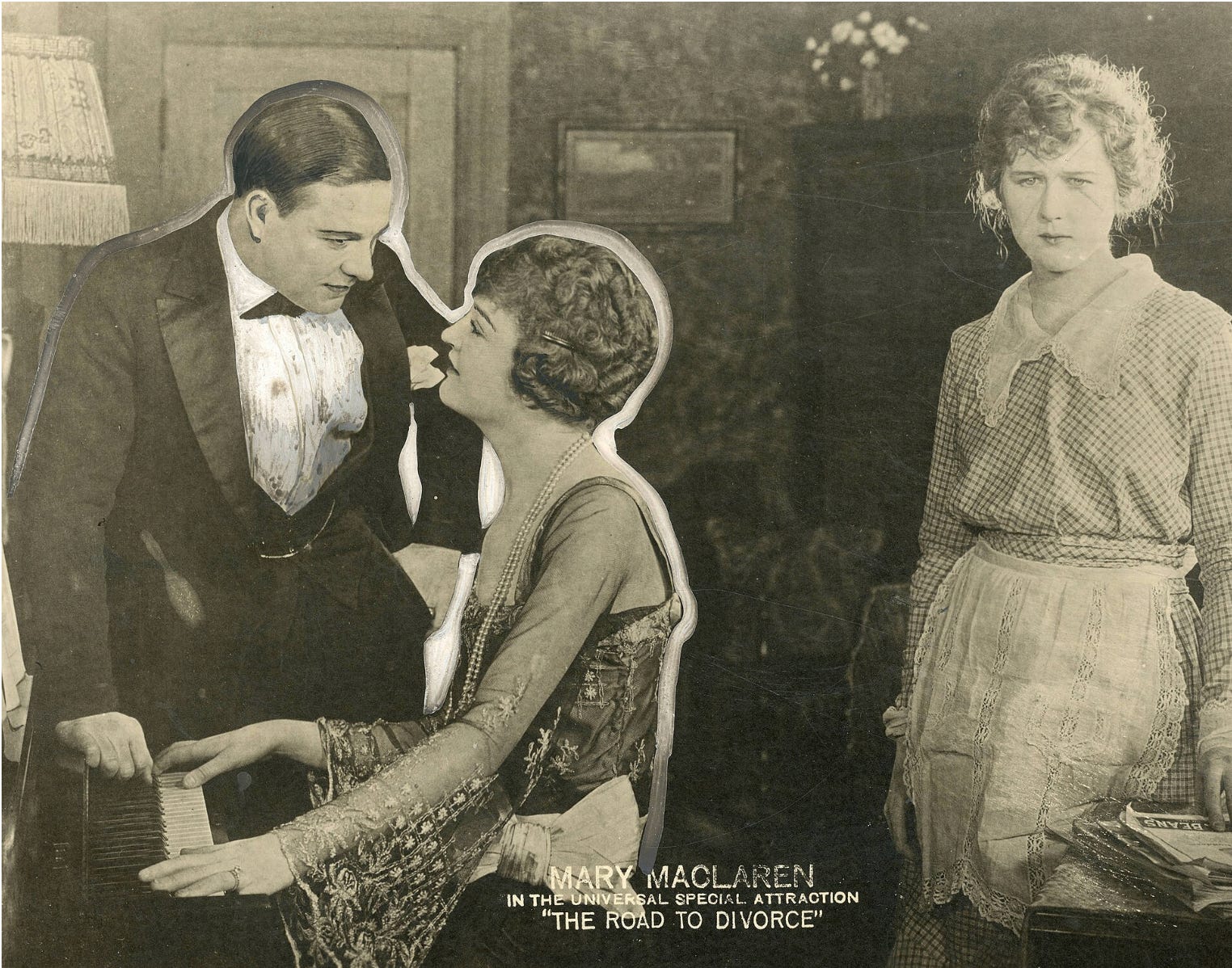
My ex recently sent me a link to an Instagram in which a boy named Paul asks his dad why his parents divorced.
“Well, Paul,” the dad answers, “it’s all your fault.”
He goes on to explain that mom and dad were completely happy before Paul was born. What ruined everything, he says, was the strain of trying to keep two careers going while also looking after a child.
And then there was the fact that mom put on weight, lost her figure, and lost interest in sex.
I laughed. Then I read the comments. Many said that while the video was a dark example of British humour, it was also quite accurate. Brutally so.
I was thinking about this when I read the recent New York Times interviews with Belle Burden.
I had earlier read Burden’s Modern Love column, Was I Married to a Stranger? I Thought I Knew My Husband of 20 Years. I Didn’t — and Still Don’t. In it, she writes about how her husband left her and their children just like that, one day, without any explanation. Five years later, Belle still has no answers. She has no clue why it happened. He did not even want shared custody of their children.
Now she has written a book about it and, as the NYT puts it, she tells the whole story. Hence the interviews.
I haven’t read Belle’s book, so what I’m about to say is not really about the book or about Belle. It’s about something her Modern Love essay made me think about: not so much marriage, but the institution of the family — the nuclear family, to be more exact.
First, something about me.
Like Belle, I was in my early 50s when my husband left me. The devastation and emotional turmoil were similar, but otherwise our situations could not have been more different.
For one thing, we were not wealthy.
Also, while my ex was totally besotted with his new love, he did not exactly leave the children. He did lose focus on them, as infatuated people often do, and for a while, he was absent from their lives, both physically and especially mentally. He was miles away even when he was there, and often he was also literally many miles away, because his new love lived on a different continent.
But I cannot say he abandoned the kids, now grown-ups. He is still very much in their lives.
Like Belle, however, I was totally shattered. I was shattered for years and, in fact, a part of me still is. There was shame and disappointment and deep hurt and despair.
And there was regret.
Standing in the smoking ruins of my marriage, I felt like I had made all the mistakes a woman can make. I had given up career prospects to support my husband and follow him around the globe. No one asked me to do that. I did it because I didn’t know what else to do.
I was educated up to a PhD, but surprisingly clueless about how to build a career. I felt there was something wrong with me. I had dreams and ambitions, but it was as if deep down I had always known that I would never really make it in this world.
When I got pregnant at 27, I felt relief. I saw it as an escape route from a world that had become too much for me to cope with. By then, I had already labelled myself a misfit.
Motherhood, I figured, would be easier than navigating the complexities of the modern world. Women had done it since prehistoric times. We are wired to reproduce. I was confident that I could do it and that it would be enough to justify my existence.
Surely being a mother would be enough?
It turned out it wasn’t.
I was never “just” a homemaker. I did do things, even paid work. While living overseas, I had projects that, although not generating income, were still worthwhile contributions to the outside world.
In Mozambique, I founded an NGO that supported local artisans. In Vanuatu, I volunteered at the cultural centre, managing the shop that sold local handicrafts. In Finland, I worked as a principal lecturer at a college for some years.
I did this and that, but nothing with my whole heart.
Unlike most women I know, I could not quite combine motherhood with a career, which is strange considering that I am a citizen of a Nordic welfare state known for gender equality, paid maternity leave, and excellent daycare.
I had jobs, but they never formed the kind of chain people call a career. I never identified as a career woman.
Sometimes I feel like a prehistoric hunter-gatherer suddenly thrown into modernity. Perhaps that is why I am obsessed with prehistory. There is a deep longing for the woods in my heart. I long to be part of nature, not this crazy-ass money-driven digital mess I find myself in.
Belle’s NYT article is about her bafflement after her husband left. She says she does not know why it happened.
But I think she does, because this is what she says in the interview:
I don’t think I was a fully realized person when I was married,” she said. “And I never would have left. So in the end, it sounds crazy, and I wouldn’t have said this a couple of years ago, but I’m glad it happened.
She was not a fully realized person.
I take this to mean that she wasn’t entirely content with her life either, as a wife and mother.
As is often the case, she only understood this after the marriage ended and she began growing into herself in a new way — something that apparently became possible only once the husband was gone. Or perhaps because of the post-traumatic growth that sometimes follows devastation.
After my divorce, I also experienced a kind of self-realisation. What do I want from this life? I asked myself during the many sleepless nights I spent staring at the ceiling.
I did some serious soul-searching that eventually took me on a spiritual journey of sorts. I studied meditation, became a meditation teacher, and started writing.
Back then, I still had a troubled teenager to care for, so I wasn’t entirely free to reinvent my life. I know I could never have left my children, not for any adventure, not for any man. Deep in my heart, I might have wanted to, but the entire idea was so alien to me that it never truly took root in my mind.
Leaving the family was easier for my husband because he knew I wasn’t going anywhere. There is some unfairness in that, but I choose not to dwell on it because if I do, my thoughts drag me into a very dark place, and Goddess knows I stayed there long enough.
I am probably not a good example of a modern human because I clearly have issues most people don’t have. Most people I know seem to cope here just fine.
But there are some broader patterns I have noticed.
People marry young, before they fully know themselves and while they are still strangers both to themselves and to their partners. Later, they may end up regretting the choices they made before they had fully grown into who they are.
The New York Times recently launched an essay series called How to Live With Regret. In one of the essays, the writer and journalist Miguel Macias takes a bold stance: he writes that he regrets becoming a parent.
If ever there was a taboo, this is one of them.
Regretting parenthood sounds selfish and wrong. And yet it happens. It is easier for a man to admit this. For a mother, it is next to impossible.
Family life is not for everyone.
A nuclear family is not for everyone.
There, I said it.
And yet many of us, at least in my generation, were raised to believe that it is.
Miguel Macias was no young man when he became a father. At 47, he was twenty years older than me and my husband when our firstborn came into the world. He writes that he loves his daughter deeply, but not the way parenthood changed his life — and he is not the only one who has mixed feelings about family life.
According to a Finnish study, 90 per cent of fathers would like to give up their maximum number of parental leave days and transfer them to the mother. In the spring of 2023, the leading Finnish newspaper Helsingin Sanomat asked men why.
Some responses were blunt.
Children are boring. Work is more enjoyable.
And:
I don’t particularly like looking after small children.
The expert interviewed in the article suspected these answers came from trolls, because surely fathers cannot think this way. The headline even hinted at that disbelief: Can We Even Say It Out Loud?
But I think it is entirely possible that many fathers do feel this way, because many mothers — and even grandmothers — secretly think the same.
Mothering in this world is as complicated as everything else. For one thing, it can be very lonely. Homo sapiens is a herd animal. Mothers are not supposed to care for their offspring alone as they do now. We are not wired to do anything without the protection and support of our tribe.
I certainly felt both bored and exhausted tending my kids, but I accepted it as part of the deal. After all, motherhood is supposed to be hard. This is what we have been told since Eve ate the apple and was cursed by God.
Is it fair that men leave their wives to deal with family life alone, making them even lonelier than before?
No. It is pretty messed up.
I feel deeply for the women, like me, who get ditched, sometimes in very difficult circumstances. With no career. No money. A sick child. And utter confusion.
But I also understand the men who leave.
In this strange world we have created, we are all actors in a play called society. Roles are assigned to us, and expectations are built into those roles.
Philosophers have argued for centuries about whether we truly have free will. I am not convinced that we do. If humans had full control over their actions, the world would probably not be such a mess.
Sure, we have some agency over small things, but most people seem to live according to a script. There are psychological, sociological, and evolutionary reasons for this. Humans have a strong desire to belong and to feel safe.
“A family” is a soothing phrase. It radiates warmth. Safety. Belonging.
But it can also become a prison. A bun.
I live as a single woman now. I live alone. For the first time in my life, I can do whatever I want. I can live a life of a fully realised woman - in theory, at least.
It is pretty amazing and also pretty…I don´t know….weird, I guess.
Most of my life, I have lived in a family, and now I don´t. I still struggle to make myself feel at home in this situation, where I am the only one making plans and the only one to cook for and the only one whose clothes spin in the washing machine.
I feel displaced.
And lonely, for sure.
Am I really fully realised even now? I have no idea.
Yes, I do “my own” things now. I even write books. This was always my dream. I did not write books when I lived in a family, but now I do.
Still, I often wonder whether I would choose family life over my present life if given the choice. This may sound terribly regressive for a feminist to say, but it is honestly how I feel.
Perhaps what I long for is not so much a family as a tribe, possessing, as I do, the soul of a prehistoric hunter-gatherer woman.
All I know is that I deeply desire belonging, and writing books does not satisfy that longing. For a long time, I told myself it did. But it doesn’t.
Still, there is a silver lining. As a writer, I can write about these mixed feelings. As Nora Ephron famously said, “Everything is copy.”
Her novel Heartburn is a brilliant example of this. In it, she tells a thinly disguised version of her own story: the joy of motherhood and family life, and the devastation of losing it after her husband leaves her.
I want to end this post with her words because she says it so well:
And then the dreams break into a million tiny pieces. The dream dies. Which leaves you with a choice: you can settle for reality, or you can go off, like a fool, and dream another dream.
I am now learning to do just that: to dream another dream, even if I still don’t quite know what it is.
Great post, Kati. I was in an unhappy marriage for 41 years until my first husband died. I wanted very much to get out and it would have been relatively easy for me. We had no children and I had a decent paying job. I just didn't have enough faith in myself to make it on my own. And I didn't want to go through all of the aftermath following a divorce. Looking back on that episode of my life, I should have made the leap. I would have been much happier striking out on my own. Nonetheless, I have found much happiness now in my second marriage. I like companionship and both my husband and I are very grateful to have met.
In Romania, when I was a young mom, I had 2 years of paternal leave. Dads can take one month from those 2 years, but with reduced salary, as moms as well. Guess what? 95%of fatherd go to work and the moms are the ones stayuing at home, because if more fiable financially. Why would he stay home if everything costs so much and as young parents you need lots of money because think if for example the mom doesn't breastfeed (it's 15 euros a can of powder milk that keeps for a few day) plus the diapers (they are machine of eating and pooping money) .
In Finland ,in my opinion, things are way to relaxed, it is a different reality than in other countries.
I personally, again agree the father's go to work , gain more money, then come home, focus on children and I have the evening free :)