
What keeps me going
and why I think our hunter-gatherer ancestors were so awesome?

I have watched the BBC documentary Human, and I am learning.
I have learned about Homo floresiensis, a small-sized “hobbit” who lived on an Indonesian island called Flores. From where, and particularly how, they came, no one really knows.
It is estimated that they lived on their island for 700,000 years (perhaps even longer) until they went extinct. Why that happened, we also do not know. One possibility is the arrival of the more clever and technologically advanced Homo sapiens, who may have taken over the island from their minuscule cousin species.
Unless they were all killed by a volcanic activity.
What strikes me is this: the hobbits had small brains (about the size of those of chimpanzees), and they used only simple stone tools, yet somehow they travelled from no one knows where to an island across the sea.
Like, how?
Hardly by accidentally floating there on driftwood.
I have lived on a South Pacific island, and I know how hard it is to sail in tropical waters.
It is also really difficult to come ashore on a tropical island because of the currents, for one thing. You have to know how to deal with the circumstances. You cannot just very well drift there.
How did these hobbits manage it?
Again, no one knows.
What we do know, thanks to archaeology, is that our lot, the wise humans, also managed to get to the same island around 46,000 years ago.
And I am asking again: how exactly did they get there? They may have been wiser than the hobbits, but they still could not build a boat.
And what made them even want to take that dangerous journey over the sea?
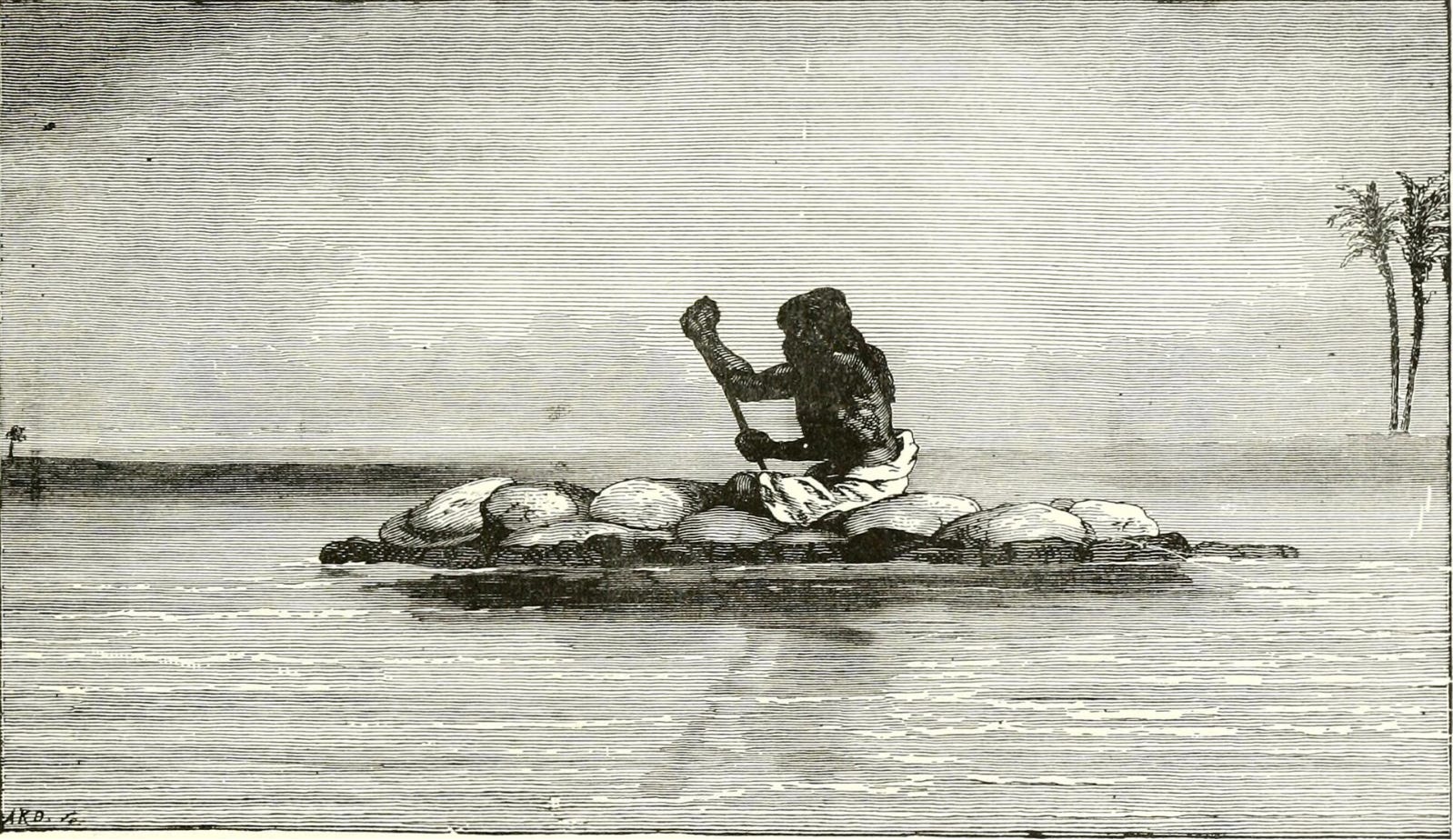
A primitive bladder boat. Wikimedia Commons
We do not have exact answers to these questions, but here is the explanation experts consider most probable: this is how our species is wired.
We are like that. We are explorers. Adventurers. Inventors. Daredevils.
Homo sapiens first emerged in Africa around 300,000 years ago. They stayed there for a long time, but eventually left. They ventured out to see what else was out there, outside their familiar territories, because this is what we humans do.
And so, around 120,000 years ago, Homo sapiens began the great migration that, slowly at first, eventually led to humans inhabiting nearly the entire planet.
I personally find this unbelievable.
Look, I know the migration was slow. It was around 12,000 years ago that Homo sapiens had occupied nearly all habitable, meaning ice-free, parts of the globe. So it did take a while.
But still.
Why this innate urge to go? Where did it come from?
Perhaps the urge came out of necessity. There were ecological changes and devastations in Africa in the early millennia of Homo Sapiens excistence. At some point, life may have become so hard at times that they saw no other option than to take to the road - and to the ocean.
But still.
They had no concept of the world as a globe, let alone maps. No technology except simple bows and arrows with stone spearheads shaped by other stones. But this did not stop them. They built basic watercraft, placed their entire families on them, and off they went, toward unknown islands and lands.
Not only did they have limited tools and technologies to build a waterproof vessel, but they also had very limited means to guide it across the big waters.
Since they most probably had no idea where they were even going, they probably just set off, trusting that what had kept them fed and safe so far would somehow guide them to where they were meant to be.
Instead of maps, they “read” the ocean and the sky and the entire creation. They navigated by the sun, the stars, the currents, the wind, wildlife, the birds.
I get teary-eyed when I think about this.
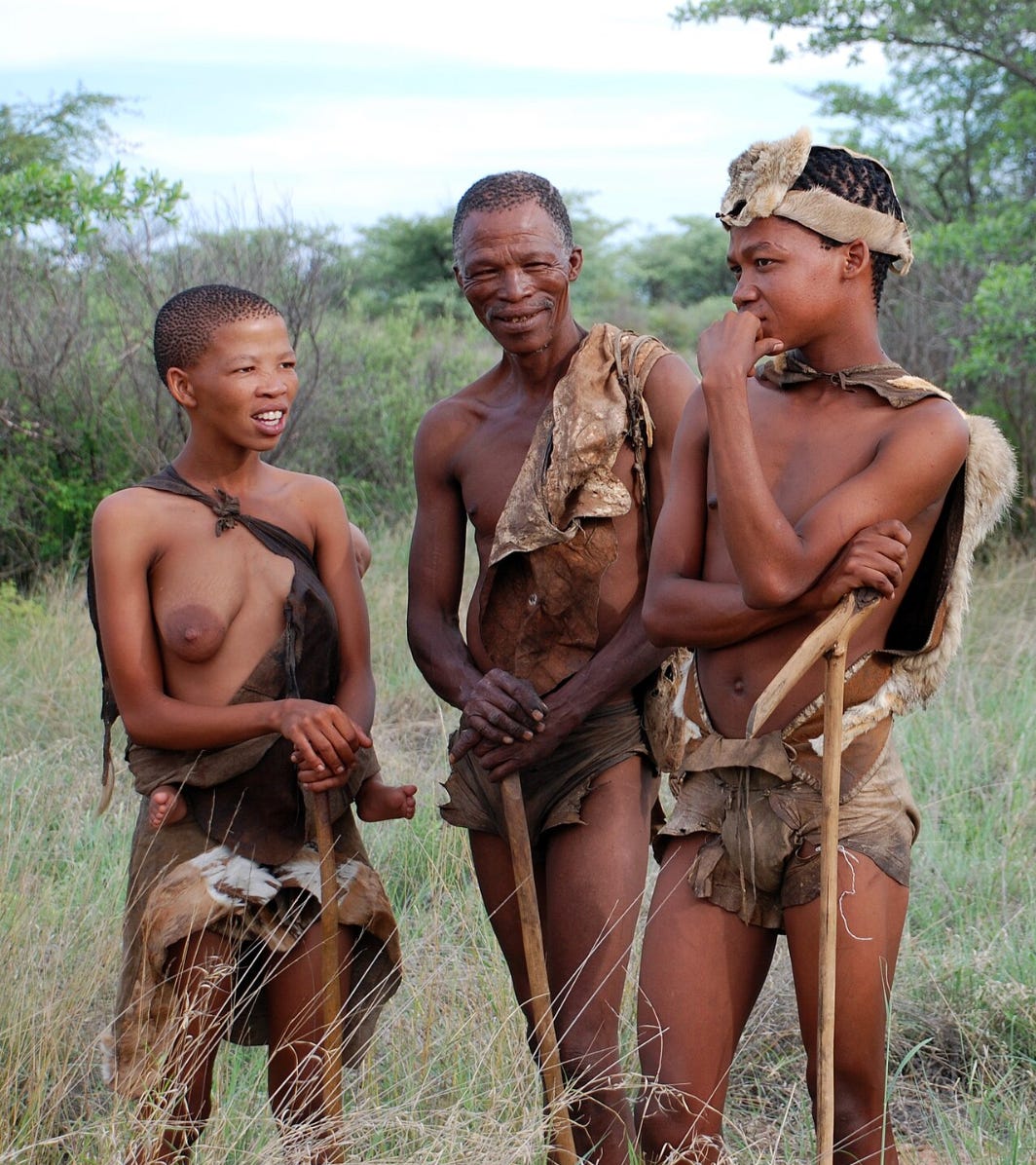
Present day San hunters (Wikimedia Commons)
Compared to us, our ancestors had practically nothing. But they had something I would give almost anything I have for: unwavering faith that they would always be provided.
I presume this because I have read what anthropologist James Suzman discovered after observing the indigenous San people for 20 years.
Suzman reported that the San spend an average of 17 hours a week gathering food and 19 hours doing household tasks. In many Western countries, the averages are closer to 40 and 36, and yet the San diet is varied, healthy, balanced, and sufficient, which is more than can be said about ours.
Most amazingly, the San do not store food or accumulate more than they need - because of the unwavering faith and trust in… I dont know what exactly.
Nature? Destiny?Spirits?
Providence?
Ever since I heard about that unwavering faith, I have been obsessed with it.
I want so badly have what they had!
And now, after watching the BBC documentary (recommended!), I am also obsessed with our ancestors’ drive.
Because I am also - and still - driven, even at the ripe age of 66.
And I see no signs of that drive fading.
I am a proud Homo Sapiens Warrior Woman.
I still do things I have never done before, things I never thought I was capable of.
For one, here I am, writing this post on an international platform, in English. In my youth, this would have been unthinkable.
And here are some other things I have done since turning 60:
I designed a functioning website on WordPress with the help of YouTube tutorials. I still cannot believe I did it. I had always thought I couldn’t.
I have worked as a content creator for a young people’s startup. They asked me!
I set up three podcasts, again, with YouTube tutorials.
I adopted a rescue dog. He is a handful - but also a heartful.
I started therapy. (I had never done it before, but I decided to give it a go while I still remember what I am anxious about and traumatised by.)
I have become a really good vegan cook.
I have turned out to be quite a capable grandma.
I am not retiring. I am not withdrawing or retreating. Instead, I am continuing this journey of discovery and growth, without any knowing where it takes me.
Like my prehistoric ancestors, I keep moving as long as the drive is there, even without the asset they apparently had - even without that unwavering faith and ability to read the sky.
I am often scared and worried and panicky, even.
But I am still moving.
If for nothing else, then in honour of my brave ancestors, who, while having no idea how to do things, did them anyway.
I am sure that deep in our DNA, there is an ingrained knowing that we are capable of far more than we imagine.
There is the drive.
Oh - and do you know what has been our species’ greatest survival asset?
Empathy.
It makes one think whether losing it will be the reason our species will one day go extinct.
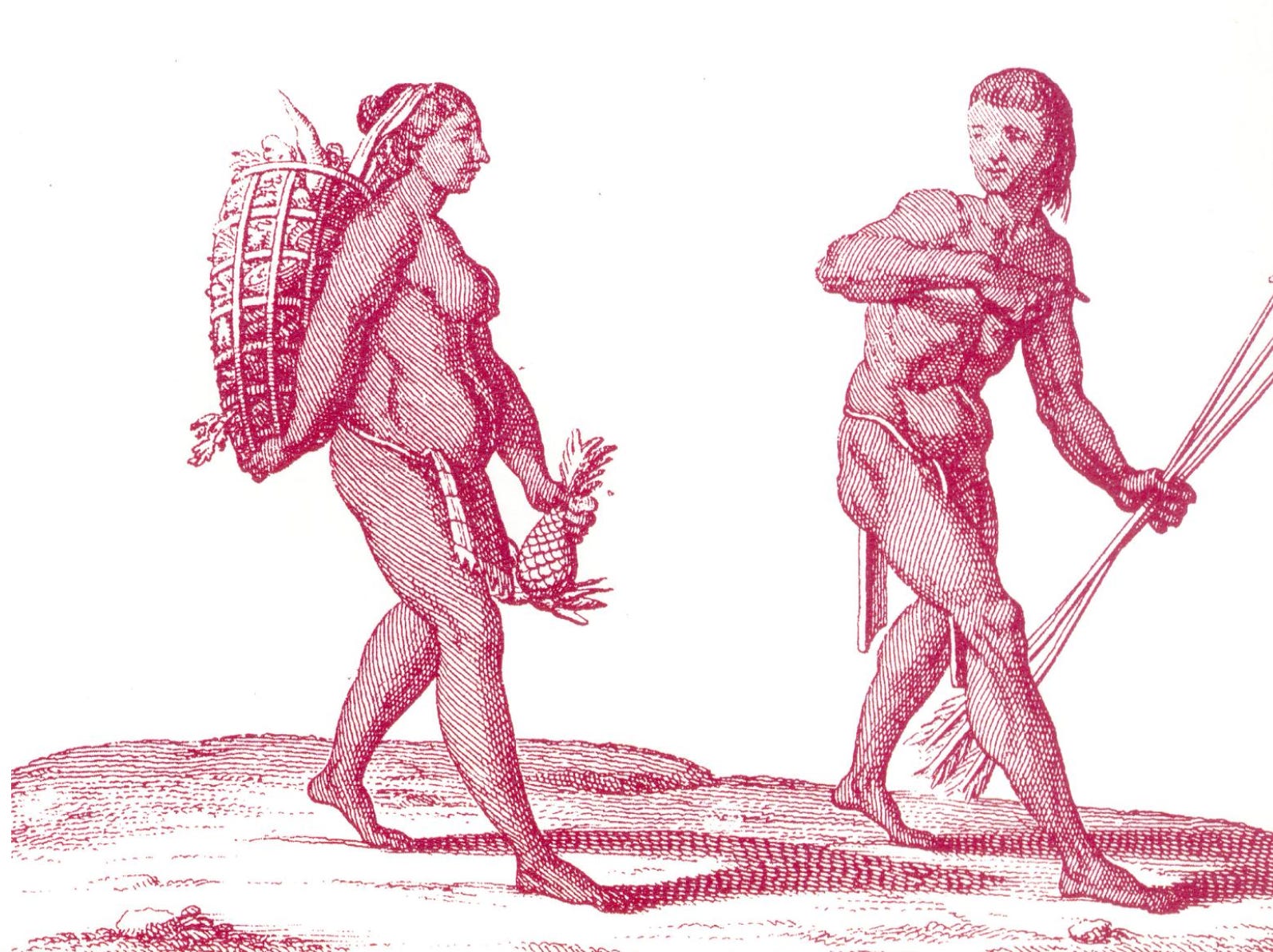
(Image above: A Kali'na hunter with a woman gatherer / Wikimedia Commons)
Kati, this is an amazing, deeply meaningful and thought-provoking article. You raise so many HUGE points and then apply them to the amazing advancement of your own life. One of the best things you have ever written (and there are others). Thank you for giving this to us.
Thank you, Kati for putting life in such a unique perspective with this piece. Certainly my existence is but a blip in the grand scheme and yet, it is such a great gift as is everyone else's; something to be grateful for and honour every day. ❤️🇨🇦